

An AI chatbot may answer questions correctly and still feel completely wrong for a business.
It might sound too formal for a friendly local company, too casual for a professional consultancy, or too promotional for a brand built around trust and personal care. It may use words the business would never use, provide answers that are unnecessarily long, or move too quickly into lead capture before helping the customer.
These problems usually happen when chatbot development focuses only on functionality.
A working chatbot needs accurate information and reliable technology, but a useful custom chatbot also needs a clear voice. Every greeting, answer, follow-up question, apology, recommendation, and handoff should feel consistent with the business it represents.
Brand voice is not simply a marketing preference. It influences how customers interpret the business.
A chatbot that sounds thoughtful, clear, and appropriate can strengthen confidence. A chatbot that feels generic or robotic may make even a well-established business appear impersonal.
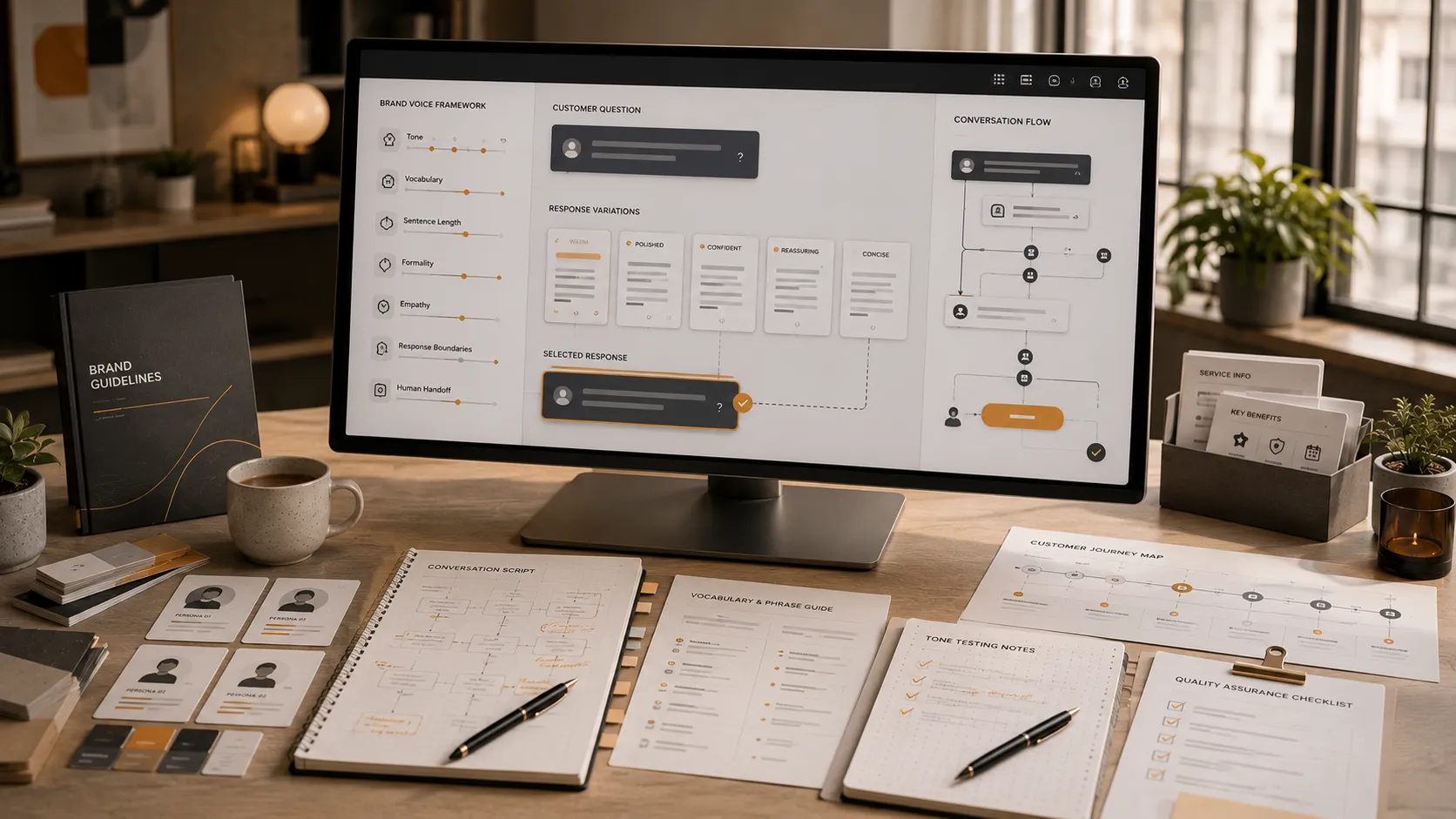
Building an AI chatbot that matches your brand voice requires more than uploading a brand guide or asking an AI model to “sound friendly.” It involves defining the voice precisely, translating it into practical conversation rules, writing real examples, testing responses, and refining the script after customers begin using it.
This guide explains how to do that effectively.
What Is Brand Voice?
Brand voice is the consistent personality and communication style a business uses when speaking to its audience.
It appears across:
- Website content
- Emails
- Social media
- Sales conversations
- Customer support
- Advertising
- Proposals
- Booking messages
- Automated communication
Brand voice is different from brand tone.
The voice is the business’s consistent personality. The tone may change depending on the situation.
For example, a brand may always be warm, clear, and professional. However, its tone may become more reassuring when handling a customer complaint, more enthusiastic when confirming a booking, and more concise when sharing technical instructions.
An effective chatbot should understand both.
It should maintain the same core identity while adjusting the emotional tone to fit the conversation.
Why Brand Voice Matters in an AI Chatbot
A chatbot often communicates with customers before a human team member does.
That means it may create the customer’s first impression of the business.
If the chatbot sounds disconnected from the website, social media, or sales team, the experience can feel inconsistent. Customers may wonder whether they are speaking with the right company or whether the chatbot understands the service at all.
Matching the brand voice helps a chatbot:
- Feel connected to the rest of the business
- Build familiarity and trust
- Provide a more polished customer experience
- Communicate information more clearly
- Reduce robotic or generic responses
- Support stronger lead and booking conversations
- Handle difficult situations more appropriately
- Maintain consistency across channels
For service businesses, this can be particularly important. Customers may be choosing between businesses that offer similar services, and the quality of communication may influence their final decision.
Step 1: Define the Brand’s Core Personality
Before writing chatbot responses, define the personality the chatbot should represent.
Avoid vague descriptions such as “professional,” “friendly,” or “human.” These words are useful starting points, but they are too broad on their own.
Two businesses can both describe themselves as friendly while communicating very differently.
A local family clinic may express friendliness through reassuring and patient language. A creative agency may sound friendly through energetic, informal, and direct language. A boutique hotel may communicate friendliness through attentive and polished hospitality.
Choose three to five specific characteristics that describe the brand.
For example:
- Warm
- Knowledgeable
- Calm
- Direct
- Considerate
Or:
- Confident
- Modern
- Clear
- Energetic
- Practical
Each characteristic should have a clear meaning.
If the brand is “confident,” determine whether that means decisive and concise or bold and promotional. If it is “warm,” decide whether that means conversational, empathetic, welcoming, or all three.
Step 2: Define What the Brand Is Not
It is often easier to understand a brand voice by defining what it should avoid.
For example, a brand may be:
- Confident, but not arrogant
- Friendly, but not overly casual
- Helpful, but not pushy
- Professional, but not stiff
- Knowledgeable, but not complicated
- Warm, but not overly emotional
- Concise, but not abrupt
These contrasts help conversation designers make better writing decisions.
Without them, one person may interpret “friendly” as using slang and jokes, while another may interpret it as adding long welcoming messages.
A clear “this, not that” framework creates stronger consistency.
Step 3: Review Existing Brand Communication
The best source of brand voice is often the communication the business already uses successfully.
Review materials such as:
- Website pages
- Sales emails
- Customer support replies
- Social media posts
- Proposals
- Brochures
- Frequently asked questions
- Booking confirmations
- Testimonials
- Recorded sales or support conversations
Look for patterns.
Which phrases appear often? Are sentences short or detailed? Does the business use “we” or the company name? Does it speak directly to the customer using “you”? Does it use industry terminology, or does it explain everything in simple language?
Also identify inconsistencies.
The website may sound polished, while customer emails are much more conversational. This does not always mean one is wrong. It may show how the brand voice changes by situation.
The chatbot script can bring those styles together into one organized framework.
Step 4: Understand the Audience
A chatbot should match the brand, but it should also be easy for the customer to understand.
The same business may communicate differently depending on its audience.
Consider:
- Customer age range
- Industry knowledge
- Reason for contacting the business
- Level of urgency
- Common concerns
- Preferred communication style
- Geographic or cultural context
- Whether the customer is an individual or a business buyer
A technical software company may serve experienced professionals who are comfortable with specialist terms. A home-service company may need to explain the same concepts in simple, practical language.
The goal is not to imitate the audience. It is to express the brand in a way the audience finds clear and appropriate.
Step 5: Create a Chatbot Voice Guide
A standard brand guide often focuses on visual identity and marketing copy. A chatbot needs a more practical conversation guide.
A chatbot voice guide should define:
Greeting Style
Decide how the chatbot introduces itself and welcomes customers.
Should it be direct?
“Hi, I can help you find the right service or answer a question.”
Or more polished?
“Welcome. I can help with service information, appointments, and general questions.”
Sentence Length
Should responses be short and conversational or more detailed and explanatory?
Chatbot messages are usually easier to read when broken into smaller sections. However, extremely short responses can feel cold or incomplete.
Vocabulary
Create a list of preferred terms and words to avoid.
For example, the business may prefer “client” instead of “customer,” “consultation” instead of “sales call,” or “service plan” instead of “package.”
Formality
Decide whether the chatbot should use contractions such as “we’re” and “you’ll,” or a more formal style such as “we are” and “you will.”
Emotional Style
Define how the chatbot expresses empathy, enthusiasm, reassurance, or urgency.
Question Style
Decide whether it asks one question at a time or presents several options together.
Call-to-Action Style
Determine how the chatbot invites the customer to book, request a quote, or share contact details without sounding aggressive.
Human Handoff Style
Define how it explains that a team member is better suited to continue the conversation.
This guide becomes the practical writing standard for the complete chatbot.
Step 6: Write Real Conversation Examples
General instructions are not enough. The chatbot needs real examples showing how the brand responds in different situations.
Write sample responses for:
- A new visitor
- A returning customer
- A pricing question
- A service recommendation
- A confused visitor
- A frustrated customer
- A request the chatbot cannot complete
- A booking inquiry
- A lead qualification question
- A human handoff
- An after-hours message
- A closing message
For example, a generic response might say:
“Please provide your contact information to continue.”
A warmer, service-focused brand might say:
“I can help the team prepare the right next step. What is the best email address for your reply?”
A direct professional brand might say:
“Share your work email, and our team will follow up with the relevant details.”
Both responses collect the same information, but the experience is different.
Real examples make the voice easier to apply consistently across the complete script.
Step 7: Script the Entire Customer Journey
Brand voice should not appear only in the greeting.
It should remain consistent throughout the conversation.
Map the chatbot’s main journeys, including:
- Customer support
- Service discovery
- Lead capture
- Lead qualification
- Appointment booking
- Quote requests
- Human escalation
- Conversation recovery
- Closing and follow-up
Then review how the brand voice appears at each stage.
A chatbot may begin warmly but become robotic during lead qualification because the questions were copied from a form. It may provide helpful answers but end with an overly aggressive sales message.
Every part of the journey should feel connected.
Step 8: Make Lead Qualification Feel Conversational
Lead qualification is one of the easiest places for a chatbot to lose its brand voice.
A sequence of questions can quickly feel like an interrogation:
“What is your name?”
“What is your budget?”
“When do you need the service?”
“What is your location?”
Instead, provide context and ask only what is needed.
For example:
“To point you toward the right option, may I ask where your business is located?”
Or:
“Project timelines help us recommend the most suitable setup. When would you ideally like to begin?”
This approach feels more natural because the customer understands why the question is being asked.
The exact wording should still match the brand. A direct brand may use fewer words, while a high-touch service brand may provide more explanation.
Step 9: Create Rules for Sensitive Situations
The chatbot will not always receive simple or positive questions.
It may encounter:
- Complaints
- Refund requests
- Angry messages
- Emergencies
- Sensitive personal information
- Questions outside the business’s expertise
- Requests for unsupported promises
- Abusive language
The brand voice should remain consistent, but the tone must adapt.
A cheerful promotional tone would be inappropriate when a customer is frustrated. The chatbot should become calmer, clearer, and more respectful.
Create rules for:
- Acknowledging the issue
- Avoiding defensive language
- Not making promises it cannot guarantee
- Collecting only necessary information
- Escalating to a human quickly
- Avoiding jokes or promotional language
- Explaining the next step clearly
This is where tone control becomes as important as brand personality.
Step 10: Define the Chatbot’s Boundaries
A strong brand voice also includes knowing what not to say.
The chatbot should have clear boundaries around:
- Pricing commitments
- Service guarantees
- Appointment availability
- Legal, medical, or financial guidance
- Refund approvals
- Account-specific decisions
- Sensitive personal data
- Unsupported service claims
A chatbot that confidently provides an incorrect answer does not strengthen the brand. It damages trust.
When information is uncertain, the chatbot should say so in a way that matches the business.
For example:
“I do not want to give you an inaccurate answer. I can collect the details and have the team confirm this for you.”
This response is transparent, helpful, and brand-safe.
Step 11: Design a Natural Human Handoff
A human handoff should feel like part of the conversation, not a system failure.
Avoid messages such as:
“I cannot process your request.”
Instead, use language that explains why human support is the better next step.
For example:
“This needs a more specific review than I can provide here. I can pass your details to the support team so they can help properly.”
The handoff should also reflect the brand’s service level.
A premium business may emphasize personal attention. A practical local service company may focus on speed and clarity.
The chatbot can collect relevant context before transferring the inquiry, but it should not delay access to human support unnecessarily.
Step 12: Test the Script by Reading It Aloud
Chatbot messages are written text, but they function like spoken conversation.
Reading the script aloud can reveal problems that are easy to miss on a screen.
Listen for:
- Sentences that are too long
- Repetitive wording
- Overly formal phrases
- Awkward questions
- Unnatural transitions
- Excessive enthusiasm
- Responses that feel like marketing copy
- Tone changes between conversation stages
A table-read process is especially useful when several people are reviewing the chatbot.
One person can read the customer messages while another reads the chatbot responses. This makes the conversation feel more real and helps identify where the script loses its natural rhythm.
Step 13: Test Different Customer Phrasing
Customers will not always use the exact words expected by the script.
A person asking about pricing may write:
- “How much is it?”
- “Can you send your rates?”
- “What does this cost?”
- “Is there a monthly fee?”
- “Do you offer different plans?”
The chatbot should understand that these questions share a common intent while still responding appropriately to the specific wording.
Test:
- Short questions
- Detailed questions
- Misspellings
- Informal language
- Multiple questions in one message
- Unclear requests
- Negative or frustrated language
The response should remain accurate and aligned with the brand regardless of how the customer asks.
Step 14: Maintain Consistency Across Channels
A business may use the chatbot on its website, WhatsApp, Instagram, Messenger, or Google Business Profile.
The core voice should remain consistent, but the message format may need to change by channel.
Website chat may allow slightly longer explanations. Social messaging often benefits from shorter, faster replies. A booking flow may need more structured questions.
Consistency does not mean every message must be identical.
It means the customer should recognize the same business personality wherever the conversation happens.
A central master script can help maintain this consistency while allowing channel-specific adjustments.
Step 15: Review Real Conversations After Launch
Brand-voice work does not end when the chatbot launches.
Real conversations reveal whether the script sounds natural in practice.
Review:
- Where customers stop responding
- Questions the chatbot misunderstands
- Responses that require frequent human correction
- Moments where the tone feels too formal or too casual
- Lead questions that feel intrusive
- Support messages that lack empathy
- Words customers use instead of the expected terminology
These insights can be used to refine the chatbot every month.
For example, if customers repeatedly ask for “pricing” while the chatbot uses the term “investment,” the script may need to include both terms. If users abandon the conversation after a long introduction, the greeting may need to become shorter.
Ongoing revisions allow the chatbot to sound increasingly natural and relevant.
Common Brand-Voice Mistakes in AI Chatbots
Several mistakes can make a chatbot feel disconnected from the business.
Using Too Many Personality Instructions
Telling the chatbot to be warm, witty, professional, playful, persuasive, empathetic, concise, detailed, and enthusiastic at the same time creates confusion.
Prioritize a few characteristics.
Copying Website Text Directly
Website paragraphs are not always suitable for conversation. Chatbot responses need to be shorter, clearer, and interactive.
Adding Too Much Humour
Humour may work in marketing but can feel inappropriate in support, pricing, or complaint conversations.
Pretending the Chatbot Is Human
The chatbot can sound natural without misleading customers about what it is.
Using the Same Tone in Every Situation
A booking confirmation and a complaint should not have the same emotional energy.
Ignoring the Client’s Real Language
The strongest brand voice often comes from how the business already speaks with customers, not from abstract marketing adjectives.
How to Know Whether the Chatbot Matches Your Brand
Ask the following questions during review:
- Does this sound like something our team would genuinely say?
- Does the chatbot use our preferred terminology?
- Is the tone appropriate for our customers?
- Does it provide enough information without overwhelming the user?
- Does it remain consistent from greeting to handoff?
- Does it sound helpful rather than promotional?
- Does it handle uncertainty honestly?
- Would a customer recognize our brand without seeing the logo?
If the answer to several of these questions is no, the chatbot needs more conversation design work.
Final Thoughts
Building an AI chatbot that matches your brand voice requires more than selecting a personality setting or adding a few friendly phrases.
The process begins by defining the business’s communication style, audience, preferred language, and boundaries. That voice must then be translated into real conversation examples, customer journeys, qualification questions, support responses, and human handoffs.
The chatbot should sound consistent, but not repetitive. It should be natural, but transparent about being automated. It should be helpful, but careful not to make promises or decisions outside its role.
Most importantly, the script should be tested and revised based on real customer conversations.
A strong brand-voice chatbot does not simply automate replies. It extends the way the business communicates across more conversations and more channels.
AIChatbotopia develops custom AI chatbots from a complete brand-voice script rather than relying on generic templates. Each conversation is planned, read-tested, deployed, monitored, and refined to help the chatbot sound like the business it represents.
Businesses can explore AIChatbotopia’s chatbot development services at https://aichatbotopia.com/services/, review available plans at https://aichatbotopia.com/pricing/, or request a tailored chatbot at https://aichatbotopia.com/get-a-quote/.